HVAC Technician vs. Degree: Calculating the True Cost of Tools, Training, and Earning Potential in Georgia
Calculating the True Cost of Entry: HVAC Career Cost Georgia vs. The Degree Path
If you are reading this, chances are you are past the initial "What should I major in?" panic. You are looking at the practical reality of funding a career in Georgia, and the decision between a structured degree program and a specialized trade apprenticeship is often shrouded in misleading cost comparisons.
The most critical insight you can act on today is this: The true cost of entering a skilled trade is not tuition; it is the total capital investment required to achieve operational readiness.
Before you even look at a college brochure, create a "Total Readiness Cost" spreadsheet. This spreadsheet must account for specialized tools, required certifications, and the time commitment of hands-on training—not just classroom hours. If you treat the cost of entry like a degree program (where tuition is the primary variable), you will drastically underestimate the capital required to actually work on a job site.
This article moves past the sticker price of tuition. We will analyze the full financial picture of becoming a skilled HVAC technician in Georgia, comparing the capital investment, earning potential, and completion rates of apprenticeships versus traditional degree paths, all grounded in verifiable federal data.
Understanding the Total Readiness Cost: Beyond Tuition
When we discuss the "HVAC career cost Georgia," most people immediately think of the cost of a technical school program. While tuition is a component, it is only one piece of the puzzle. To truly compare paths, we must analyze the Total Readiness Cost (TRC).
The TRC is defined as: $TRC = (Tuition/Program Fees) + (Tools/Equipment) + (Certification Fees) + (Time/Opportunity Cost)$
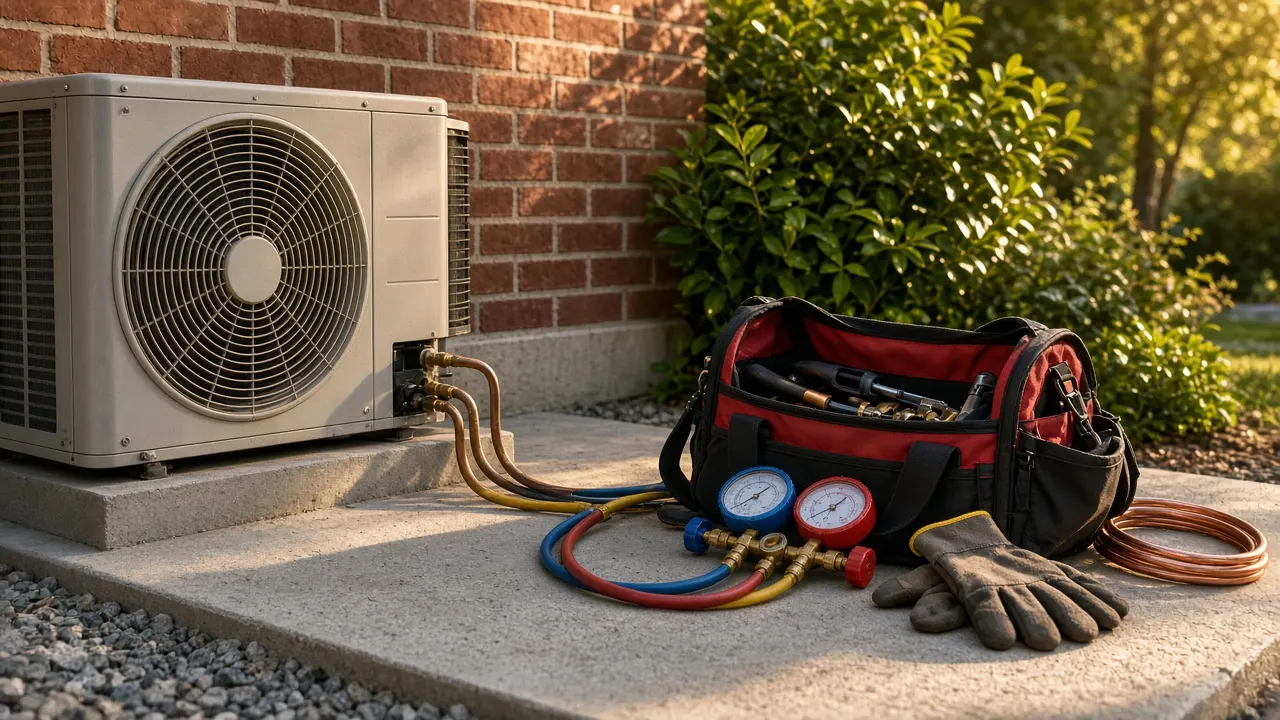
The Capital Investment Checklist (Tools and Equipment)
A degree program assumes you will be given the tools. In reality, professional trades require significant upfront capital.
- Diagnostic Tools: Multimeters, specialized gauges, refrigerant recovery machines. These are not cheap and are required for initial employment.
- Personal Protective Equipment (PPE): Safety glasses, gloves, specialized uniforms, ladder safety gear.
- Specialized Kits: Manifold gauges, vacuum pumps, and portable testing equipment.
The Limitation of the Metric: It is crucial to understand that the cost of tools depreciates, and professional industry standards change. A $500 tool kit today may not be adequate for a complex commercial chiller unit five years from now. Always budget for professional-grade, durable equipment, not entry-level hobby gear.
The Opportunity Cost of Time
This is the most frequently ignored cost. If you spend two years in a program, you are spending two years earning little to no income. If you enter an apprenticeship, you are earning a wage while you are trained.
- Apprenticeship Model: The cost is the time spent earning wages while receiving structured, paid training. The opportunity cost is minimized.
- Traditional Degree Model: The cost is the time spent in classrooms, potentially delaying entry into the workforce and thus delaying earning potential.
Apprenticeships vs. Degree Paths: A Comparative Analysis
The choice between an apprenticeship and a degree is fundamentally a choice between time-based earning and credential-based learning. Neither is inherently superior; they are simply different financial models for achieving professional competency.
The Apprenticeship Model: Earning While Learning
Apprenticeships are structured, paid on-the-job training programs. For HVAC, this means working alongside licensed professionals while receiving classroom instruction on theory and code compliance.
How it Works:
- Entry: You secure an entry-level role with an HVAC company that sponsors or participates in an apprenticeship program (often through local community colleges or industry associations).
- Training: You spend 3-5 days a week working, and the remaining time in structured coursework.
- Compensation: You are paid a percentage of a journey-level worker’s wage, which increases incrementally as you gain skills.
Federal Wage Data Context: According to the Bureau of Labor Statistics (BLS), the median annual wage for HVAC technicians is consistently reported. While wages vary dramatically by region (Atlanta vs. Macon, for example), the BLS data provides a reliable baseline for understanding the earning potential of a skilled technician. This data is invaluable because it tells you the destination wage, regardless of the path taken.
The Key Advantage: The immediate flow of income mitigates the financial pressure of schooling. The employer has a vested interest in your success because you are their future workforce asset.
The Technical Degree Model: Structured Theory First
A technical degree (Associate of Applied Science, AAS) provides a deep theoretical foundation in subjects like thermodynamics, electrical theory, and building codes, often in a compressed timeframe.
How it Works:
- Enrollment: You enroll at a technical college or community college.
- Training: You complete coursework and potentially participate in simulated lab environments.
- Outcome: You graduate with a credential that signals theoretical mastery, which can be highly valuable for roles involving design, commercial controls, or project management.
The Limitation of the Metric: A degree proves knowledge; an apprenticeship proves competency. While a degree is excellent for theory, the industry still requires practical, supervised hours. A graduate who has never handled a refrigerant recovery machine in a live environment is still incomplete.
Deep Dive: Analyzing Earning Potential and Career Trajectories
When comparing paths, the goal is not just to earn a high salary, but to build a durable, high-earning career.
Trajectory 1: The Technician Path (Apprenticeship Focus)
This path prioritizes immediate, hands-on competency. You start as an apprentice, work your way up, and gain deep, practical knowledge of the physical systems.
- Initial Earning: Lower than a journeyman, but immediate.
- Progression: Steady, skill-based wage increases.
- Career Capstone: Becoming a Master Technician or Field Service Manager.
- The Value: Deep, specialized knowledge of failure points and repair procedures. This is the bread-and-butter of the industry.
Trajectory 2: The Controls/Design Path (Degree Focus)
This path often requires a stronger theoretical foundation, making it ideal for those who want to move into the commercial, high-end, or controls side of the industry.
- Initial Earning: May require some entry-level labor to build practical hours.
- Progression: Increases tied to specialized certifications (e.g., NATE, specific BMS/BAS systems).
- Career Capstone: Building Management Systems (BMS) Engineer, Design Consultant, or Project Manager.
- The Value: The ability to manage complex, multi-system installations and communicate with architects and engineers.
Actionable Step: The Hybrid Approach The most successful professionals often combine both. They use a technical degree to master the theory (e.g., advanced electrical schematics) and then use an apprenticeship to master the application (e.g., wiring that schematic into a live system).
Decoding the Certifications: What Employers Actually Pay For
Certifications are the modern currency of the skilled trades. They are often more valuable to an employer than a piece of paper from a college, because they prove that you passed a specific, measurable test.
Essential HVAC Certifications to Target
- EPA Section 608 Certification: Non-negotiable. This proves you are legally allowed to handle refrigerants. This is the absolute minimum requirement for working on most modern HVAC units.
- NATE (North American Technician Excellence): A highly respected, voluntary certification that demonstrates competence in specific areas (e.g., Heat Pumps, Air Conditioning). It signals to employers that you have gone above and beyond basic requirements.
- Manufacturer-Specific Training: Being certified on a specific brand's equipment (e.g., Carrier, Trane) is invaluable, as these companies often require certified techs for their premium service contracts.
The Checklist Approach: Instead of viewing certifications as a final goal, treat them as milestones. When you start, your goal is the EPA 608. When you are mid-career, your goal is NATE. This structured approach makes the learning process manageable and financially phased.
Financial Planning for the HVAC Career Cost Georgia
Let’s build a realistic budget based on the average adult learner scenario.
Scenario: The 25-Year-Old Adult Learner
- Goal: Enter the workforce quickly, minimize debt, and build a high-earning foundation.
- Recommended Path: Apprenticeship model combined with targeted community college coursework.
| Expense Category | Estimated Cost (Range) | Notes/Funding Options | | :--- | :--- | :--- | | Tuition/Program Fees | $1,000 - $4,000 | Focus on AAS degrees or certificate programs. Check for GI Bill eligibility. | | Core Tools/Equipment | $800 - $2,000 | Buy quality, but don't overspend initially. Look for used/refurbished diagnostic gear. | | Certifications (EPA/NATE) | $500 - $1,500 | Costs vary by testing center. These are non-negotiable expenses. | | Transportation/Materials | $500 - $1,000 | Includes gas, travel to job sites, and small consumable materials. | | TOTAL ESTIMATED TRC | $2,800 - $8,500 | This range accounts for a low-cost apprenticeship vs. a highly specialized, commercial-focused program. |
The Crucial Funding Tip: Do not view these costs as debt. View them as investments that are paid back through the wage increase differential between a non-skilled job and a skilled technician wage. The return on investment (ROI) is incredibly fast.
The Role of the Local Community College
For adult learners, the local community college is often the most strategically sound starting point. They are designed to bridge the gap between academic theory and industry practice.
- Flexibility: They often offer certificate programs that can be completed in 9-12 months, allowing you to start earning money faster than a four-year university.
- Industry Ties: Community colleges in metropolitan areas like Atlanta are often directly partnered with local HVAC contractors. These partnerships are critical because they provide the direct pipeline to apprenticeships—the single most important step.
- Resource Access: They provide access to lab equipment and instructors who are often actively working in the field, ensuring the curriculum is current with industry standards.
A successful program doesn't just teach you how to fix a unit; it teaches you how to navigate the local labor market and connect you with employers who need your specific skills. For a detailed look at how local educational institutions are structuring these career pathways, compare owner tools.
Next Step
The key to success in the skilled trades is not finding the "best" school, but finding the school that provides the most direct, affordable, and actionable pathway into paid, hands-on work.
When you are ready to put this workflow into practice, browse live listings to compare local programs and understand the specific costs and certifications available in your area.
Compare every Georgia college
Independent data on every college in Georgia